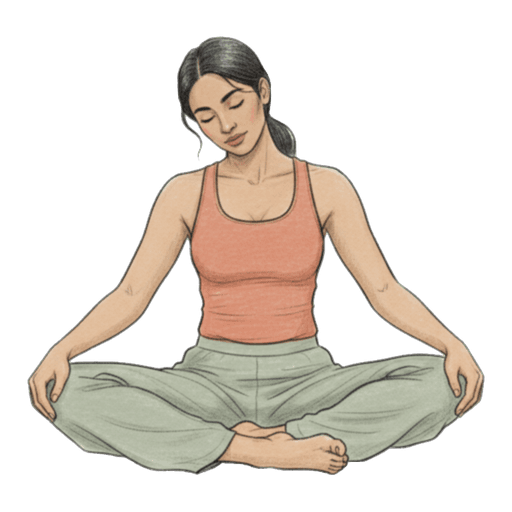
Understanding Hip Flexor Anatomy: The Iliopsoas Complex
The hip flexors are a vital muscle group located at the front of the hip and upper thigh. Their primary function is to bring the knee toward the chest and to assist in flexing the trunk forward at the hip 2. The most significant component of this group is the iliopsoas, which is a combination of the psoas major and the iliacus. The psoas major originates from the lumbar vertebrae (L1-L5) and the T12 vertebra, passing through the pelvis to attach to the femur 10.
Other muscles that contribute to hip flexion include the rectus femoris, the sartorius, and the tensor fasciae latae. Flexibility refers to the ability of soft tissues to stretch passively, while mobility involves active movement through a full range of motion 2. Both are necessary for daily activities like walking. Research indicates that stretching major muscle groups at least two to three days a week can improve range of motion and joint function 1.
The Science of Sitting: Adaptive Shortening
The human body is designed for movement, yet many adults spend upward of eight hours a day seated. This sedentary behavior places the hip flexors in a shortened state for long periods. Over time, this can lead to adaptive shortening, where the body may reduce the number of functional units in muscle fibers to adapt to the new length 9.
When you sit, your hips are flexed at approximately 90 degrees. In this position, the gluteal muscles are lengthened and relatively inactive, while the hip flexors are shortened. This imbalance is sometimes referred to as reciprocal inhibition. Implementing hip flexor stretches for sitting is about breaking up this sedentary time and providing the muscles with the stimulus needed to maintain their natural elasticity.
How Hip Tension Affects Lumbar Alignment
Because the psoas major attaches to the lumbar spine, its tension can influence the alignment of the lower back. When the hip flexors are chronically tight, they can pull on the lumbar vertebrae, potentially increasing the forward curve of the lower spine, known as increased lumbar lordosis 10. This constant pull can lead to a feeling of stiffness in the lower back after a long day of sitting.
Addressing hip flexibility supports the entire kinetic chain. The American Heart Association emphasizes the importance of warming up before activity and cooling down afterward 7. By introducing gentle stretches targeting the iliopsoas and rectus femoris, you can help manage the tension from hours of desk work. The American College of Sports Medicine (ACSM) suggests that for most adults, a stretching program should be performed at least two to three days a week 8.
5 Essential Hip Flexor Stretches for Desk Workers
When performing these stretches, move slowly and avoid bouncing. Focus on deep, regular breathing throughout each movement. You should aim for a sensation of mild tension, never pain.
- Seated Hip Flexor Extension: Sit toward the front edge of a sturdy chair, turn your body to one side, and drop the outside knee toward the floor while keeping your torso upright 3.
- Half-Kneeling Lunge: Kneel on one knee with the other foot flat in front of you, gently tuck your pelvis under, and shift your weight forward until you feel a pull in the front of the kneeling hip 1.
- Standing Quadriceps Pull: Stand on one leg (using a wall for balance), grasp your opposite ankle behind you, and gently pull your heel toward your glutes while keeping your knees aligned 1.
- Seated Figure-Four: While sitting, cross one ankle over the opposite knee and gently lean forward from the hips with a flat back to mobilize the hip joint 5.
- Seated Knee-to-Chest: Sit back in your chair, lift one knee toward your chest, and hold it with both hands for 10–15 seconds to encourage hip joint mobility 5.
Static vs. Dynamic Stretching for Desk Workers
Choosing the right type of stretching depends on your immediate goal. Dynamic stretching involves active movement and is typically used to prepare the body for activity by increasing blood flow 4. Static stretching involves holding a position at the end of the range of motion and is often used to improve long-term flexibility 6.
For desk workers, a combination is often most effective. Dynamic movements like seated hip circles can be used as movement breaks throughout the day. Static stretches are better suited for a dedicated session at the end of the day. According to the Cleveland Clinic, dynamic stretching mimics the activity you are about to perform 4. Conversely, the NHS suggests that static stretching after exercise can help muscles return to their resting length and reduce post-activity stiffness 6.
| Feature | Dynamic Stretching | Static Stretching |
|---|---|---|
| Primary Goal | Prepare for movement/warm-up | Increase passive flexibility/cool-down |
| Movement Type | Controlled, repetitive motion | Stillness at end-range |
| Duration | 10–12 repetitions per side | 30–60 second holds |
| Physiological Effect | Increases blood flow & muscle temp | Relaxes muscle spindles |
| Best Time to Use | Before exercise or during breaks | After exercise or in the evening |
| Desk Worker Benefit | Quickly breaks up sedentary time | Addresses long-term muscle tightness |
How BendEase makes this easier
Integrating a regular stretching routine into a busy workday can be challenging without the right tools. While many stretching apps offer basic guidance, BendEase provides a curated library of over 150 stretches, including pre-built routines specifically designed for desk workers and those focusing on hip flexor flexibility. The app offers personalized routine generation based on your focus areas, experience level, and feedback, ensuring that you are always working within a comfortable and safe range of motion.
With visual guided playback and a choice of three voice coaches, BendEase takes the guesswork out of your daily movement breaks. Whether you are using the custom routine builder to target specific hip stretches for sitting or following a premium personalized plan, the app helps you track your progress through activity history, streaks, and body heat maps. The automatic progression feature ensures your routines evolve as your flexibility improves, while weekly goals keep you motivated. While other platforms may offer community sharing or video demonstrations, the app focuses on a streamlined, guided audio-visual experience for individual users.
References
- 1 https://www.mayoclinic.org/healthy-lifestyle/fitness/in-depth/stretching/art-20546848
- 2 https://www.hingehealth.com/resources/articles/mobility-vs-flexibility/
- 3 https://www.mayoclinic.org/healthy-lifestyle/adult-health/in-depth/office-stretches/art-20046041
- 4 https://health.clevelandclinic.org/dynamic-stretching-vs-static-stretching
- 5 https://www.nhs.uk/live-well/exercise/flexibility-exercises/
- 6 https://www.nhs.uk/live-well/exercise/how-to-stretch-after-exercising/
- 7 https://www.heart.org/en/healthy-living/fitness/fitness-basics/warm-up-cool-down
- 8 https://pubmed.ncbi.nlm.nih.gov/21694556/
- 9 https://pubmed.ncbi.nlm.nih.gov/33188982/
- 10 https://my.clevelandclinic.org/health/body/psoas-muscle