Why stretching alone is harder than it looks
Stretching sounds simple: get into a position, hold it, breathe. In practice there are several things to juggle at once.
- Remembering the steps. Even a five-stretch routine has a sequence, and each stretch has its own setup.
- Keeping time. Counting seconds in your head pulls your attention away from the stretch, and it's easy to count faster when a position is uncomfortable.
- Checking form. Without a cue, it's easy to shrug your shoulders, hold your breath or push further than you should.
- Switching sides evenly. It's easy to give one side a longer hold without noticing.
A guide that speaks takes the first, second and fourth jobs away from you entirely and helps with the third. That leaves you with the part that matters: paying attention to how the stretch feels. If you're new to stretching, our guide on how to start stretching covers the basics to pair with this.
The four benefits of being talked through it
1. You can close your eyes (when it's safe to)
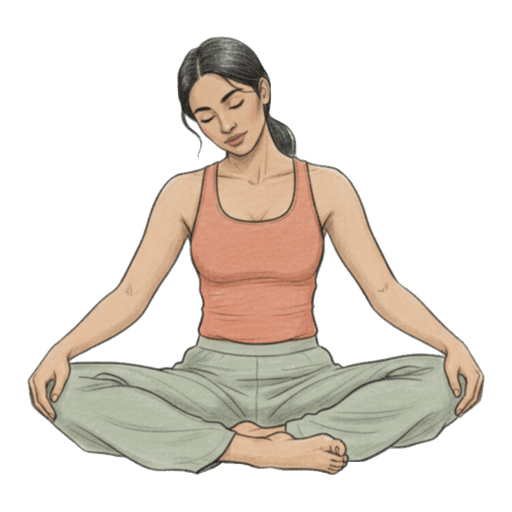
When you don't need to read instructions or watch a timer, you can close your eyes in seated and lying positions. Many people find this makes it easier to notice where a stretch is landing and to let go of tension they didn't know they were holding.
Keep your eyes open for standing stretches, balance poses and transitions between positions. Vision plays a big part in balance, and closing your eyes while standing on one leg is a different exercise altogether.
2. Form cues while you hold
A good guide doesn't just name the stretch. It tells you what to do once you're there: "let your shoulders slide away from your ears", "keep your back long as you lean", "a soft bend in the knee is fine". These small reminders catch the most common mistakes in the moment, rather than after the session.
There's some research behind the style of cue, too. A large set of meta-analyses on motor skills found that cues pointing your attention at the effect of a movement (an external focus, such as "reach toward the wall") tended to produce better performance and learning than cues focused on individual body parts 1. That research covers motor skills in general rather than stretching specifically, so treat it as a useful principle rather than proof.
3. Timing you don't have to think about
How long you hold matters. The American College of Sports Medicine (ACSM) recommends flexibility exercises for each major muscle-tendon group on at least two days a week, adding up to about 60 seconds per exercise 6. The Canadian Centre for Occupational Health and Safety suggests holds of around 10 to 20 seconds for quick workstation stretches, breathing normally and never bouncing 5.
A voice can hold you there for the full time and spread it across both sides evenly. It can also break a 60-second target into two or three shorter holds, which many people find more comfortable. The NHS similarly suggests doing flexibility exercises at least twice a week and building up gradually 7.
4. Relaxation and breathing
A voice can pace your breathing: "breathe in… and as you breathe out, let your knees get heavy." Slow breathing techniques have been linked in a systematic review with increased heart rate variability and reported feelings of comfort and relaxation 3. Separately, a randomised study found that 20 minutes of progressive muscle relaxation, deep breathing or guided imagery, each delivered by recorded audio instructions, increased participants' sense of relaxation compared with a control group 2.
Neither study looked at stretching itself, so we can't claim a guided stretch routine has the same effect. But the ingredients overlap: a calm voice, slow breathing and attention on your body. The NHS breathing exercise for stress, for example, simply asks you to breathe gently into your belly, counting to five on the way in and out, for at least five minutes 4. It's easy to layer that kind of breathing into the long holds of a guided routine.
What good voice guidance sounds like
Not all guidance is equally helpful. When you're choosing a recording, an app or writing your own script, listen for these qualities:
| Quality | What it sounds like | Why it helps |
|---|---|---|
| Clear entry | "Lie on your back, knees bent, feet flat." | You get into position without looking. |
| A settle cue | "Let your back rest heavy… and breathe." | Gives you a moment to adjust before the hold starts. |
| Spaced hold cues | One short cue every 10–15 seconds | Keeps attention on the stretch without constant chatter. |
| An easier option | "If your knee feels tight, hold behind your thigh instead." | Lets you scale the stretch on the spot. |
| A clear exit | "Gently release… and let both legs rest long." | Avoids rushing out of a position. |
| Side switches | "Now the other side." | Keeps both sides even. |
The most common problem is too much talking. Good guidance leaves quiet space during the hold.
How to do voice guided stretching well
- Set up before you press play. Clear a space, grab a mat or towel, and put your phone or speaker where you can hear it without reaching for it. If a stretch needs a wall or a chair, have it nearby.
- Use a speaker or one earbud for floor work. Lying on bulky headphones is uncomfortable.
- Choose a voice you like. You'll hear it a lot, and a voice that irritates you makes it harder to come back.
- Start short. Five to ten minutes is enough to learn how the guidance flows. Our daily stretching routine for beginners is a good template.
- Close your eyes only when you're supported. Open them for standing work and when changing positions.
- Take the easier option when offered. The voice sets the pace; your body still decides how far to go. You should feel a gentle pull, never pain 5.
- Breathe with the voice. Let each "breathe out" be slow and complete. Exhales are a natural moment to soften into a stretch.
- Stay in the stillness. Resist fidgeting or checking your phone during quiet moments. That's where much of the relaxation happens.
A sample 8-minute voice guided routine
Here's a short floor routine that works well with your eyes closed. Read it into a voice memo, ask someone to read it to you, or use an app that guides these stretches. Hold most for about 30 seconds per side.
- Cat Cow. Start on hands and knees, wrists under shoulders and knees under hips. Breathe in as you lift your chest and chin; breathe out as you round your back and tuck your chin. Move slower than you think you need to. Keep your eyes open for this one while you find your position.
- Single Knee-to-Chest. Lie on your back, slide your left leg out long and draw your right knee in, hugging it gently with both hands. Let your back rest heavy. If your knee feels tight, hold behind your thigh instead. Switch sides.
- Double Knee Spinal Twist. With knees bent and arms out wide, breathe out and let both knees fall to one side. Keep both shoulder blades on the floor. Bring them back to centre and repeat on the other side.
- Lying Figure Four. Cross your left ankle over your right knee, lift your right foot and hold behind your right thigh. Keep your tailbone heavy. If your knee feels strained, leave your right foot on the floor. Switch sides.
- Reclined Butterfly. Bring the soles of your feet together and let your knees fall open. Rest your arms out, palms up. Let gravity do the work; slide a cushion under each knee if your hips pull.
- Legs-up-the-Wall. Sit sideways next to a wall, lie back and swing your legs up. Let the wall hold your legs and breathe slowly for a minute or two. To come out, bend your knees and roll onto your side.
Summary of the sample routine
| Stretch | Main areas | Hold |
|---|---|---|
| Cat Cow | Spine, upper and lower back | 5–8 slow breaths |
| Single Knee-to-Chest | Glutes, hips, lower back | 30 seconds per side |
| Double Knee Spinal Twist | Lower back, obliques, spine | 30 seconds per side |
| Lying Figure Four | Glutes, outer hips | 30 seconds per side |
| Reclined Butterfly | Inner thighs, hips | 45–60 seconds |
| Legs-up-the-Wall | Hamstrings, lower back | 1–2 minutes |
These are all static stretches, which suit a calm, voice-led session. To prepare for exercise, a dynamic routine is a better fit; see dynamic vs static stretching. Over time, rotate in new stretches so all your major muscle groups get attention 6.
How BendEase makes this easier
BendEase is built around voice guided stretching. On iPhone, a voice coach talks you into each pose, cues you through the hold and tells you when to switch sides, so you can put your phone down and close your eyes for floor and seated work. There are six coaches to choose from: Elizabeth and Cam are free, and Emily, Isabel, Kai and Leo come with Premium.
The library covers 200+ stretches with hand-drawn illustrations, and Premium adds guided video demos of every stretch if you want to check form before you start. When you first set up the app, you tap where you feel tight on a body map and mention any sensitive joints, such as knees, lower back or wrists. BendEase leaves out stretches that load those areas, offers gentler options, and builds a personalised plan that adapts to your feedback.
You can also stretch along on the big screen with Apple TV, or run a routine from your wrist with Apple Watch; your plan and progress sync with the same Apple ID. The free plan includes two coaches, illustrated stills and one guided routine a day. Premium unlocks all six coaches, videos, unlimited routines and stats such as streaks, weekly goals and a body heat map, and new users can try everything free for 48 hours with no card. BendEase is not medical advice.
References
- 1 https://pubmed.ncbi.nlm.nih.gov/34843301/
- 2 https://pmc.ncbi.nlm.nih.gov/articles/PMC8272667/
- 3 https://pmc.ncbi.nlm.nih.gov/articles/PMC6137615/
- 4 https://www.nhs.uk/mental-health/self-help/guides-tools-and-activities/breathing-exercises-for-stress/
- 5 https://www.ccohs.ca/oshanswers/ergonomics/office/stretching.html
- 6 https://pubmed.ncbi.nlm.nih.gov/21694556/
- 7 https://www.nhs.uk/live-well/exercise/flexibility-exercises/
Ready to be talked through your next stretch? Try BendEase.