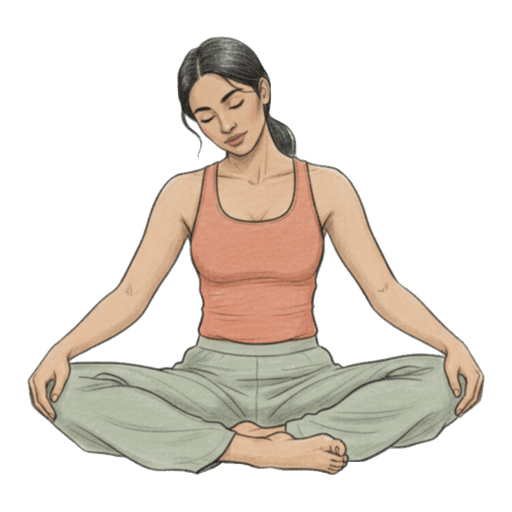
The Physiology of Waking Up: Why We Feel Stiff
Morning stiffness is a physical reality rooted in your body's biology. During sleep, your body remains still for several hours, leading to changes in the connective tissues. The fascia—the casing of connective tissue surrounding your muscles—can become slightly less hydrated during periods of inactivity 1. This contributes to the sensation of being "locked in" when you first rise. Your body temperature is typically at its lowest point in the early morning. Muscles are less pliable when cold, and the synovial fluid that lubricates your joints is more viscous 4. A morning stretching routine acts as a gentle internal heater. By engaging in light movement, you increase blood flow to these tissues, which helps to warm them up and restore the natural glide between layers of fascia and muscle 7. This process encourages the body to return to its optimal state of fluid motion rather than pushing your limits.
The Benefits of a Morning Stretching Routine
Incorporating a morning stretching routine into your daily life offers benefits beyond simple flexibility. The true value lies in the cumulative effect of consistent, low-stress movement. According to the Mayo Clinic, regular stretching can help improve your range of motion, which supports your ability to perform everyday tasks with greater ease 1. This is particularly important for maintaining functional independence as we age and our natural elasticity begins to decrease. Beyond the physical mechanics, a morning routine provides a crucial moment of focus. Short bouts of movement, often called "movement snacks," are supported by the American College of Sports Medicine (ACSM), which notes that even brief periods of flexibility training are beneficial when performed regularly 8. A 5-minute wake up stretch routine is much more sustainable than a long gym session, making it a reliable way to build a long-term habit of physical activity.
Dynamic vs. Static Stretching: Which is Better for Mornings?
When designing a morning stretching routine, it is helpful to understand the difference between dynamic and static stretching. Static stretching involves holding a single position for a set duration, typically 15 to 60 seconds. This is excellent for lengthening muscle fibers and is often used at the end of a workout when the muscles are already warm 6. However, first thing in the morning, holding a deep static stretch can sometimes feel uncomfortable if the muscles are still cold. Dynamic stretching involves moving parts of your body and gradually increasing reach or speed. These are controlled, rhythmic movements that take your joints through their range of motion without holding the end position 4. For a morning routine, dynamic movements are often preferred because they stimulate the production of synovial fluid and increase local blood flow more effectively than static holds alone 3.
Mobility vs. Flexibility: A Guide to Controlled Movement
Flexibility refers to the ability of a muscle to lengthen passively through a range of motion. For example, if an external force pushes your leg toward your chest, the distance traveled is a measure of your flexibility 2. Mobility, however, is the ability of a joint to move actively through a range of motion. This requires not only flexibility but also strength and motor control 2. In a morning stretching routine, the goal is often to improve mobility so you can move through your day with less effort. Understanding this distinction allows you to focus on moving your joints through their natural patterns with control. This active engagement helps to reinforce healthy movement patterns, making your daily activities feel smoother. As Hinge Health points out, you need both to move well; flexibility provides the potential for movement, while mobility provides the ability to execute it 2.
| Feature | Flexibility | Mobility |
|---|---|---|
| Primary Focus | Muscle and tendon length | Joint function and control |
| Nature of Movement | Passive (external force) | Active (muscle engagement) |
| Key Requirements | Tissue extensibility | Strength and coordination |
| Morning Application | Reducing specific tightness | Preparing joints for daily tasks |
| Example Exercise | Touching toes (passive hang) | Deep squat (active control) |
| Health Benefit | Increased muscle length | Improved movement efficiency 2 |
Your 5-Minute Morning Stretching Routine
This routine is designed to be performed in a small space. Focus on your breathing—slow, deep inhales and exhales—as you move through each step. The goal of this gentle morning mobility session is to feel better in your body, not to reach a specific level of flexibility.
- Standing Overhead Reach: Stand with feet hip-width apart. Inhale as you reach both arms toward the ceiling. Imagine growing taller without lifting shoulders toward ears. Hold for 2 to 3 deep breaths, then exhale as you slowly lower your arms.
- Gentle Neck Rotations: Slowly turn your head toward your left shoulder. Hold for a second, then return to center and repeat on the right side 4. Avoid sudden movements. Perform 3 rotations on each side to address sleep-related stiffness.
- Shoulder Rolls and Shrugs: Lift your shoulders toward your ears, then roll them back and down in a circular motion. Repeat 5 to 10 times to release tension. The NHS notes that keeping shoulders down during neck stretches is crucial for safety 4.
- Standing Cat-Cow (Modified): Place hands on thighs with a slight bend in knees. As you inhale, gently arch your back (Cow). As you exhale, round your spine and tuck your chin (Cat). Complete 5 slow repetitions for spinal mobility.
- Lateral Side Bends: Stand with feet hip-width apart and arms at sides. Slide your left hand down your left leg, feeling a stretch along your right side 4. Hold for 2 seconds, then return to center and repeat on the right.
- Standing Quad Stretch: Place one hand on a wall for balance. Bend your right knee and grasp your ankle, pulling your heel toward your glutes 1. Keep knees close and back straight. Hold for 15 to 20 seconds, then switch legs.
- Calf Stretch: Stand facing a wall with hands against it. Step one foot back, keeping the leg straight and the heel flat. Lean forward until you feel a pull in your calf 1. Hold for 15 to 20 seconds on each side.
Choosing the Right Tool for Your Stretching Journey
When selecting a digital companion for your morning stretching routine, consider which features align with your habits. The table below compares several popular options based on their official feature sets.
| Feature | BendEase | Peloton App | StretchIt | Down Dog |
|---|---|---|---|---|
| Primary Delivery | Voice-coached guided routines | Video-based classes | Video-based classes | AI-generated video |
| Stretching Focus | Dedicated 200+ library | Part of general fitness | Flexibility & splits | Yoga & mobility |
| Customization | Custom routine builder | Filter by duration/type | Structured challenges | Custom time/focus |
| Visual Aids | Hand-drawn illustrations; video demos (Premium) | Video demonstration | Video demonstration | Video demonstration |
| Personalization | Body-map plan that adapts to feedback | Class recommendations | Goal-based programs | Brand new class |
| Platform | iPhone, Apple TV, Apple Watch | Multi-platform 9 | Mobile & Web 10 | Mobile & Web 13 |
Editorial Independence Disclosure: This comparison is based on an impartial evaluation of features listed on each provider's official website as of late 2026. While BendEase offers a specialized focus on curated stretching and body heat maps, other apps like Peloton 9 or StretchIt 10 may be preferred by users who enjoy full-length video instruction. Confirm specific feature availability directly with each provider during your selection process.
How BendEase makes this easier
Integrating a morning stretching routine into a busy schedule is simpler with the right support. BendEase is an iPhone app with a library of 200+ stretches, each shown with a hand-drawn illustration. When you set it up, you tap where you feel tight on a body map, such as a stiff lower back or neck after sleep, and flag any sensitive joints so it leaves out stretches that load them and offers gentler options. It then builds a personalized plan that adapts to your feedback, and you can save your own wake-up sequence too: the free plan allows up to 3 custom routines of 6 stretches. A voice coach talks you into each pose, cues you through the hold and tells you when to switch sides, so you can focus on your movement rather than a timer, even before your eyes are fully open.
You can choose from six coaches: Elizabeth and Cam are free, and Emily, Isabel, Kai and Leo come with Premium. If you would rather stretch along on the big screen, the Apple TV app lets you follow your routine in the living room, and your plan and progress sync with the same Apple ID. The free plan includes two coaches, illustrated stills and one guided routine a day. Premium ($4.99/week or $89.99/year) adds all coaches, guided video demos of every stretch, unlimited routines and stats such as streaks, weekly goals and a body heat map, and new users can unlock everything free for 48 hours with no card. BendEase is a guide for gentle movement, not medical advice.
References
- 1 https://www.mayoclinic.org/healthy-lifestyle/fitness/in-depth/stretching/art-20546848
- 2 https://www.hingehealth.com/resources/articles/mobility-vs-flexibility/
- 3 https://www.mayoclinic.org/healthy-lifestyle/adult-health/in-depth/office-stretches/art-20046041
- 4 https://health.clevelandclinic.org/dynamic-stretching-vs-static-stretching
- 5 https://www.nhs.uk/live-well/exercise/flexibility-exercises/
- 6 https://www.nhs.uk/live-well/exercise/how-to-stretch-after-exercising/
- 7 https://www.heart.org/en/healthy-living/fitness/fitness-basics/warm-up-cool-down
- 8 https://pubmed.ncbi.nlm.nih.gov/21694556/
- 9 https://www.onepeloton.com/app
- 10 https://stretchitapp.com/
- 11 https://yogastudioapp.com/
- 12 https://play.google.com/store/apps/details?id=com.gaiam.yogastudio
- 13 https://www.downdogapp.com/