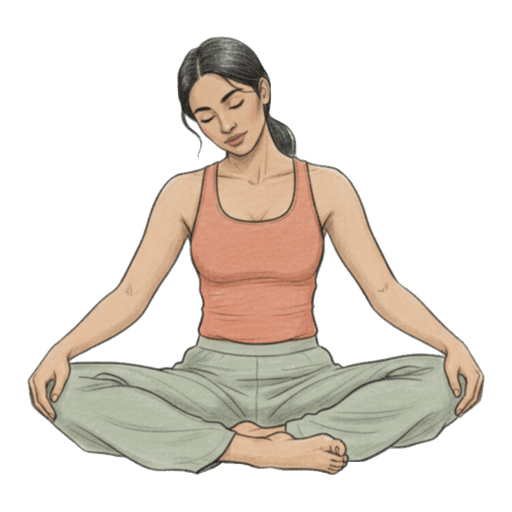
Why hips get tight
Most of us spend much of the day with our hips bent at roughly 90 degrees: at a desk, in the car, on the sofa. Harvard Health notes that sitting all day can leave muscles such as the hamstrings tight, and lists the hip flexors among the muscle groups that matter most for staying mobile 5. When a joint rarely visits the ends of its range, those ranges can start to feel stiff.
"Tight" is a feeling, not a diagnosis. You do not need to know exactly what is behind it to stretch gently, but pay attention to where you feel it, because that tells you which group to work on.
The four muscle groups behind tight hips
Hip flexors (front of the hip)
The main hip flexor is the iliopsoas, made up of the psoas, which runs from the lower back through the pelvis to the top of the thigh bone, and the iliacus, which sits inside the pelvis 2. Together they lift your thigh and help stabilise your lower back 2, with help from the rectus femoris in the quadriceps 1. If the front of your hip feels tight when you stand tall or take a long stride, start here. Our guide to hip flexor stretches for sitting goes deeper on this group.
Glutes (back of the hip)
The gluteus maximus is the largest and strongest muscle in the body and powers standing, walking and climbing. The smaller gluteus medius and minimus move your leg out to the side and help rotate the thigh 3. Tight glutes often show up as a stiff seat when you bend forward or bring a knee toward your chest.
Deep rotators (underneath the glutes)
Beneath the glutes sit several small muscles that help turn the thigh, the best known being the piriformis. It runs from the lower spine through the buttock to the top of the thigh, and the sciatic nerve usually passes underneath it 4. These are what you feel in figure-four and 90/90 positions, and they are a good target if sitting cross-legged is hard.
Adductors (inner thigh)
The adductors, including the adductor longus and magnus and the gracilis, bring your thighs together. They also help with balance and with rotation at the hip 1. Inner-thigh tightness tends to show up when you step wide, squat with your feet apart, or try to let your knees fall open.
8 stretches for tight hips
Move slowly, breathe steadily, and stop where you feel a clear but comfortable pull. A mat, a cushion and a folded towel will help. Short on time? Pick one stretch from each muscle group. Start with holds of 20 to 30 seconds per side; see how long to hold a stretch for more detail.
- Hip Circles (warm-up). Stand with your feet hip-width apart, hands on your hips and knees slightly bent. Draw slow circles with your hips, then switch direction halfway through. Keep the circles small if your lower back is sensitive.
- Kneeling Psoas (hip flexors). From kneeling, step your left foot forward into a low lunge with your right knee down. Keep your front knee stacked over your ankle and squeeze your right glute to open the front of the right hip. For more stretch, reach your right arm up and over and lean gently to the left. Fold a towel under the back knee if it is tender.
- Couch Stretch (hip flexors and quads, stronger option). Kneel with your back to a chair, lift your right shin onto the seat with the knee on the floor, then step your left foot forward and slowly bring your chest up tall. Keep your ribs down so you do not arch your lower back. Skip it if kneeling bothers your knee.
- Lying Figure Four (glutes and rotators). Lie on your back with your knees bent. Cross your left ankle over your right knee, then lift your right foot and hold behind your right thigh to draw it in. Keep your tailbone heavy and press the left knee gently away. If your knee feels strained, keep the right foot on the floor.
- Seated Figure Four (chair-friendly glute stretch). Sit tall on a chair and cross one ankle over the opposite thigh, just above the knee. Lengthen your spine and lean forward from your hips. Rest your ankle lower on your shin if your knee complains. Useful if getting to the floor is not practical.
- 90/90 (rotators). Sit with your knees bent and feet wide, then let both knees fall to one side so each leg forms roughly a 90-degree angle. Turn to face your front shin, place your hands down and hinge gently over the front leg with a straight back. Sitting on a cushion makes this kinder on the knees.
- Butterfly (adductors). Sit with the soles of your feet together and let your knees fall out to the sides. Sit tall and hold your feet. Slide your feet further away if your hips or knees are tight. For a more relaxed version, try the Reclined Butterfly on your back, with a cushion under each knee.
- Adductor Rocks (adductors, moving). From hands and knees, stretch your right leg straight out to the side with the foot flat. Keeping your back flat, rock your hips slowly back and forward to feel the inner thigh lengthen. Fold a towel under the kneeling knee if needed.
Once these feel comfortable, the Pigeon is a deeper option for the glutes and rotators. Treat it as a progression rather than a starting point, and use a cushion under your hip if your knee is not happy.
Summary of hip stretches
| Stretch | Main area | Position | Suggested dose |
|---|---|---|---|
| Hip Circles | Whole hip (warm-up) | Standing | 30–60 seconds, both directions |
| Kneeling Psoas | Hip flexors | Kneeling | 20–30 seconds per side |
| Couch Stretch | Hip flexors, quads | Kneeling | 20–30 seconds per side |
| Lying Figure Four | Glutes, rotators | Lying | 20–30 seconds per side |
| Seated Figure Four | Glutes, rotators | Chair | 20–30 seconds per side |
| 90/90 | Rotators | Seated on floor | 20–30 seconds per side |
| Butterfly | Adductors | Seated on floor | 20–30 seconds |
| Adductor Rocks | Adductors | Hands and knees | 8–10 slow rocks per side |
Building a hip routine you will actually do
Pick by feel. Front of the hip? Spend more time on the kneeling psoas and couch stretch. Cross-legged sitting hard? Favour the figure-fours and 90/90. You do not have to do all eight every time.
Warm up first. A few minutes of walking or the hip circles above makes held stretches feel easier. The National Institute on Aging advises stretching when your muscles are warmed up, remembering to breathe, and not stretching so far that it hurts 7.
Keep it regular. Harvard Health suggests stretching daily if possible, or at least three or four times a week, and warns against bouncing 5. Ten minutes most evenings beats one long session on a Sunday. If you sit a lot, add short movement breaks too; see stretches for sitting all day.
Respect your knees and back. Many hip stretches load the knee (kneeling, 90/90, pigeon). Use padding, choose the chair or lying version, or skip a stretch that does not suit you.
When tight hips need more than stretching
Stretching is for everyday stiffness, not for injuries or unexplained pain. The NHS advises booking a GP appointment if hip pain stops you doing normal activities or disturbs your sleep, keeps getting worse or coming back, has not improved after two weeks of home care, or if your hip stays stiff for more than 30 minutes after you wake up 6. It recommends urgent advice if severe pain comes on suddenly without an injury, if the hip is hot or swollen, or if you have hip pain with a fever. Call emergency services if you have severe hip pain after a fall or injury, cannot put weight on the leg, or have numbness or tingling in the hip or leg after an injury 6.
If pain travels from your buttock down your leg, see a professional for an assessment before stretching into it.
How BendEase makes this easier
Working out which of these stretches you need is the hard part. When you set up BendEase, you tap where you feel tight on a body map, so you can mark your hips specifically, and tell it about sensitive joints such as your knees or lower back. It leaves out stretches that load them and offers gentler options, which matters for hip work, since so many hip stretches involve kneeling. It then builds a personalised plan that adapts to your feedback.
During a session, a voice coach talks you into each pose, cues you through the hold and tells you when to switch sides, so you can keep your eyes off the screen and stay in the stretch. Elizabeth and Cam are free; Emily, Isabel, Kai and Leo come with Premium. The library has 200+ stretches with hand-drawn illustrations, and Premium adds guided video demos of every stretch, handy for positions like 90/90. You can also build your own hip routine: the free plan allows up to 3 routines of 6 stretches, while Premium is unlimited and adds stats such as streaks, weekly goals and a body heat map showing which areas you have worked.
BendEase runs on iPhone, Apple TV and Apple Watch, with your plan and progress synced through your Apple ID. The free plan includes two coaches, illustrated stills and one guided routine a day. Premium is $4.99/week or $89.99/year, and new users can unlock everything free for 48 hours with no card. BendEase is a stretching guide, not medical advice.
References
- 1 https://my.clevelandclinic.org/health/body/21936-thigh-muscles
- 2 https://my.clevelandclinic.org/health/body/psoas-muscle
- 3 https://my.clevelandclinic.org/health/body/gluteal-muscles-glutes
- 4 https://my.clevelandclinic.org/health/diseases/23495-piriformis-syndrome
- 5 https://www.health.harvard.edu/staying-healthy/the-importance-of-stretching
- 6 https://www.nhs.uk/conditions/hip-pain/
- 7 https://www.nia.nih.gov/health/exercise-and-physical-activity/three-types-exercise-can-improve-your-health-and-physical
For guided hip routines you can follow at home, visit BendEase.