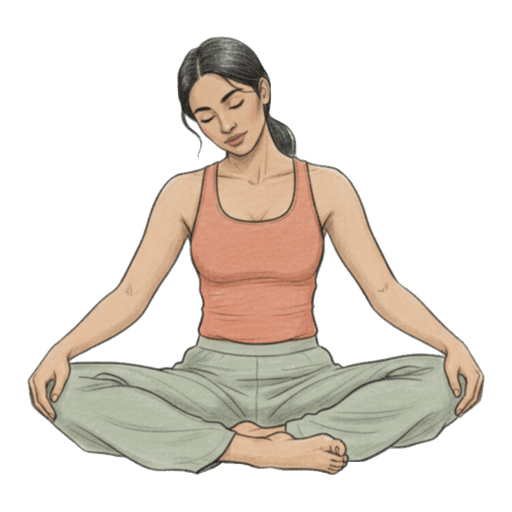
Lower back stretches work best when they're gentle, slow and short enough to do every day. This 5-minute routine uses seven moves physiotherapists commonly suggest: a pelvic tilt, knee-to-chest, a lying rotation, a figure four, cat-cow, and two chair stretches for desk days. Stretch to mild tension only, never into pain.
This isn't medical advice — follow your doctor or physiotherapist. Stretching is general information, not a treatment. If your pain is severe, spreads down your leg, or started after a fall or injury, see a clinician before trying these.
Quick answer
For a stiff lower back, the stretches most often recommended by clinical sources are knee-to-chest, a lying lower back rotation, a pelvic tilt and cat-cow, plus stretches for the glutes and hamstrings that attach to the pelvis (Mayo Clinic, Cedars-Sinai). Move slowly, breathe, and stop if a stretch makes your pain worse.
Why your lower back feels tight
Lower back pain is extremely common. The World Health Organization says it affected 619 million people worldwide in 2020 and is the single leading cause of disability. In about 90% of cases there is no specific disease or structural cause that can be identified, which doctors call non-specific low back pain (WHO).
Desk work is one piece of the picture. The US National Institute of Arthritis and Musculoskeletal and Skin Diseases lists it as a possible factor, "especially if you have poor posture or sit all day in an uncomfortable chair," along with low fitness, weak core muscles and stress (NIAMS).
The good news is that most back pain is not serious. The NHS says it usually improves within a few weeks, and that staying active and trying exercises and stretches can help speed recovery (NHS). The UK's NICE guideline on low back pain likewise puts encouragement to continue normal activities at the centre of self-management (NICE NG59).
Stretch or see someone first?
| Situation | What to do |
|---|---|
| General stiffness after sitting, or a mild ache that eases as you move | Gentle stretches like the ones below are a reasonable place to start |
| Pain that gets worse during or after stretching | Stop, and see a GP or physiotherapist (NHS) |
| Pain that spreads into the buttock or down the leg, or numbness or tingling | See a doctor before stretching (NIAMS) |
| Back pain after a fall, accident or injury | Get checked first (NIAMS) |
| Severe pain that starts suddenly or gets worse quickly, or you feel hot, shivery or unwell | Ask for an urgent appointment (NHS) |
| Numbness, tingling or weakness in both legs, numbness around the genitals or bottom, or changes in bladder or bowel control | Emergency care now (NHS) |
The 5-minute lower back stretch routine
Each stretch below links to its step-by-step page in the BendEase stretch library. The times add up to about five minutes. Use them as a guide, not a rule: Mayo Clinic suggests starting with a few repetitions of each move and building up as it gets easier.
| # | Stretch | Position | Rough time | What it targets |
|---|---|---|---|---|
| 1 | Pelvic tilt | Lying on your back | 45 sec | Lower back, core |
| 2 | Single knee-to-chest | Lying on your back | 30 sec per side | Lower back, glutes |
| 3 | Double knee-to-chest | Lying on your back | 30 sec | Lower back, hips |
| 4 | Lying lower back rotation | Lying on your back | 30 sec per side | Lower back, obliques |
| 5 | Lying figure four | Lying on your back | 30 sec per side | Glutes, outer hip |
| 6 | Cat-cow | Hands and knees | 45 sec | Whole spine |
| 7 | Seated figure four or seated rotation | In a chair | 30 sec per side | Hips, lower back |
You'll find more options, sorted gentlest first, on the BendEase lower back stretches page.
Step-by-step: how to do each stretch
- Pelvic tilt. Lie on your back with your knees bent and feet flat. Tighten your belly and gently flatten your lower back toward the floor, hold for about five seconds, then relax. Mayo Clinic suggests starting with five repetitions and slowly working up. See the pelvic tilt press.
- Single knee-to-chest. From the same position, draw one knee toward your chest with both hands, then switch sides. Mayo Clinic suggests short holds repeated two to three times; Cedars-Sinai's physical therapist suggests working up to a 30-second hold. Either is fine, so pick what feels comfortable. See single knee-to-chest.
- Double knee-to-chest. Bring both knees in and hold behind them or over the tops of your knees. Cedars-Sinai notes this lengthens the lower back muscles and "usually feels good." See double knee-to-chest.
- Lying lower back rotation. With knees bent and shoulders on the floor, slowly let both knees fall to one side, hold, come back to the middle, then switch. Keep both shoulder blades down and the movement small. See the double knee spinal twist.
- Lying figure four. Cross one ankle over the opposite knee, then draw the legs toward you until you feel the outer hip and glute stretch. Cedars-Sinai calls the glutes and hamstrings "the most important muscles to stretch" if you're dealing with low back pain. See lying figure four.
- Cat-cow. On hands and knees, slowly round your back up as you breathe out, then let your belly drop and lift your chest as you breathe in. Mayo Clinic suggests 3 to 5 rounds, twice a day. See cat-cow.
- One chair stretch. Sit on a sturdy chair without wheels. Either cross one ankle over the opposite thigh and lean forward a little from the hips (seated figure four), or cross one leg over the other and gently turn toward the top knee, which is Mayo Clinic's seated lower back rotational stretch. Hold about 10 seconds and switch sides.
Desk-day version: three stretches without leaving your chair
If getting on the floor at work isn't realistic, these three can be done in an ordinary chair:
- Seated figure four, as in step 7.
- Seated rotation: sit tall, cross one leg over the other and turn gently toward the top knee (Mayo Clinic).
- Seated hamstring stretch: perch on the edge of the seat, rest one heel on the floor with the toes up, and lean forward slightly from the hips until you feel a gentle stretch, with no pain, down the back of the leg. The Chartered Society of Physiotherapy suggests holding it for 20 seconds and repeating three times (CSP).
The same physiotherapy body is blunt about posture: there is no single perfect way to sit, and "your best posture is your next posture." It recommends breaking up sitting with a little movement about every 30 minutes. For tight hips from sitting, our guide to hip flexor stretches for people who sit all day pairs well with this routine, and the 5-minute desk stretching routine covers the upper body.
Mistakes to avoid
- Pushing into pain. "Don't push past the point of discomfort into pain," says Cedars-Sinai's physical therapist. A stretch should feel like mild tension. Forcing it can leave you sorer than when you started.
- Bouncing or rushing. Cedars-Sinai's physical therapist advises taking your time and relaxing into each stretch. Move slowly and hold still, especially in the twists, so you can feel when to stop.
- Holding your breath. It's easy to brace without noticing. Keep breathing, and breathe out as you ease into each stretch, as in cat-cow and the lying rotation.
- Only stretching the back. The hamstrings and glutes connect to the pelvis and lower spine, so skipping them leaves out part of the picture. Our guide to stretches for tight hips covers the rest of the hip.
- Staying in bed. The NHS advises against long periods in bed with back pain. Gentle movement and keeping up your usual activities usually helps more.
How BendEase helps
BendEase is a voice-coached stretching app for iPhone, Apple Watch and Apple TV. You tap where you feel tight, such as your back, and get a daily routine of about five minutes from a library of 200+ stretches, with a coach talking you through each hold. You can also tell it what's sore, such as your lower back or knees, and it leaves out stretches that load those areas and offers a gentler option where there is one. It isn't medical advice, and it doesn't replace a clinician. If you'd like a routine that changes with your feedback, you can download BendEase on the App Store. It's free to start, with 48 hours of Premium to try.
FAQ
How do you loosen a tight lower back?
Gentle movement usually helps more than staying still. Slow stretches such as knee-to-chest, a lying rotation and cat-cow move the lower back through a comfortable range, and stretching the hips and hamstrings helps too. Go to mild tension only, and stop if a stretch makes the pain worse.
Should I stretch my lower back if it hurts?
The NHS suggests exercises and stretches for back pain but says to stop if your pain gets worse and see a GP. Get medical advice before stretching if the pain is severe, spreads down your leg, came on after a fall or injury, or comes with numbness, weakness or fever.
Can I do lower back stretches while sitting at my desk?
Yes. A seated figure four, a seated rotation and a seated hamstring stretch can all be done in an ordinary chair without wheels. Physiotherapists also suggest getting up and moving about every 30 minutes, which matters as much as any single stretch.
Can I do lower back stretches in bed?
Several of these stretches start lying on your back with your knees bent, including the pelvic tilt, knee-to-chest and the lying rotation. A firm surface makes them easier to control. If your mattress is very soft, the floor or a mat is a steadier option.
How often should I do lower back stretches?
Mayo Clinic suggests doing its back routine once in the morning and once in the evening if possible, starting with a few repetitions and building up as it gets easier. A short routine you repeat most days is easier to keep than a long one you skip.
When should I see a doctor about lower back pain?
The NHS advises seeing a GP if back pain hasn't improved after a few weeks of home care, stops you doing daily activities, or is worse at night. Get urgent help for severe pain that starts suddenly, pain after a serious accident, or numbness, tingling or weakness in both legs, or changes in bladder or bowel control.
This isn't medical advice — follow your doctor or physiotherapist. If your pain is severe, spreads down your leg, or followed an injury, see a clinician.
Sources
- World Health Organization. Low back pain (fact sheet). https://www.who.int/news-room/fact-sheets/detail/low-back-pain
- NHS. Back pain (last reviewed 5 March 2026). https://www.nhs.uk/conditions/back-pain/
- NIAMS (NIH). Back pain: symptoms, types and causes. https://www.niams.nih.gov/health-topics/back-pain
- Mayo Clinic. Back exercises in 15 minutes a day (22 July 2026). https://www.mayoclinic.org/healthy-lifestyle/adult-health/in-depth/back-pain/art-20546859
- Cedars-Sinai. The best stretches and exercises for lower back pain (28 May 2025). https://www.cedars-sinai.org/stories-and-insights/expert-advice/the-best-stretches-and-exercises-for-lower-back-pain
- Chartered Society of Physiotherapy. Working from home: easy exercises. https://www.csp.org.uk/public-patient/keeping-active-healthy/staying-healthy-work/desk-based-exercises
- NICE. Low back pain and sciatica in over 16s: assessment and management (NG59), recommendations. https://www.nice.org.uk/guidance/ng59/chapter/Recommendations